| Home |
| Make | Model | Type | Works ? | 'Works' info source | Comment | Data sheet | Pin 1 requirement |
|---|---|---|---|---|---|---|---|
| AMD | AM27C256-150 | EPROM | Yes | modem7 at the VCFF | Make-model verified by electronic signature (device ID). See note 2. | Download | No (page 6) |
| Atmel | AT27C256R | PROM | Yes | Moogle! at the VCFF | OTP EPROM (an EPROM without a window for erasing). Verified - see note 2. | Download | Yes (page 3) |
| Atmel | AT28C256 | EEPROM | Yes | Malc at the VCFF | Not a 27256/27C256 equivalent - see here. | Download | |
| Intel | D27256-20 | EPROM | Yes | modem7 at the VCFF | Make-model verified by electronic signature (device ID). See note 2. | Download | Yes |
| National Semiconductor | NMC27C256Q | EPROM | Yes | mrmanse at the VCFF | Download | Yes (page 8) | |
| NEC | µPD27256 | EPROM | Download | Yes (page 1) | |||
| NEC | µPD27C256 | EPROM | No | mrmanse at the VCFF | More info at here. Note that NEC normally do not print the "µP" prefix on their chips. | Download | Yes (page 3) |
| NEC | µPD27C256A | EPROM | Download | Yes (page 4) | |||
| Signetics | S27C256-15 | EPROM | Yes | modem7 at the VCFF | Make-model verified by electronic signature (device ID). See notes 2 and 3. | Download | Yes (page 2) |
| ST Microelectronics | M27C256B-12 | EPROM | Yes | modem7 at the VCFF | Make-model verified by electronic signature (device ID). See note 2. | Download | Yes (page 3) |
| Texas Instruments | TMS27C256 | EPROM | Maybe | See note 1 below | See note 1 below | Download | Yes (page 3) |
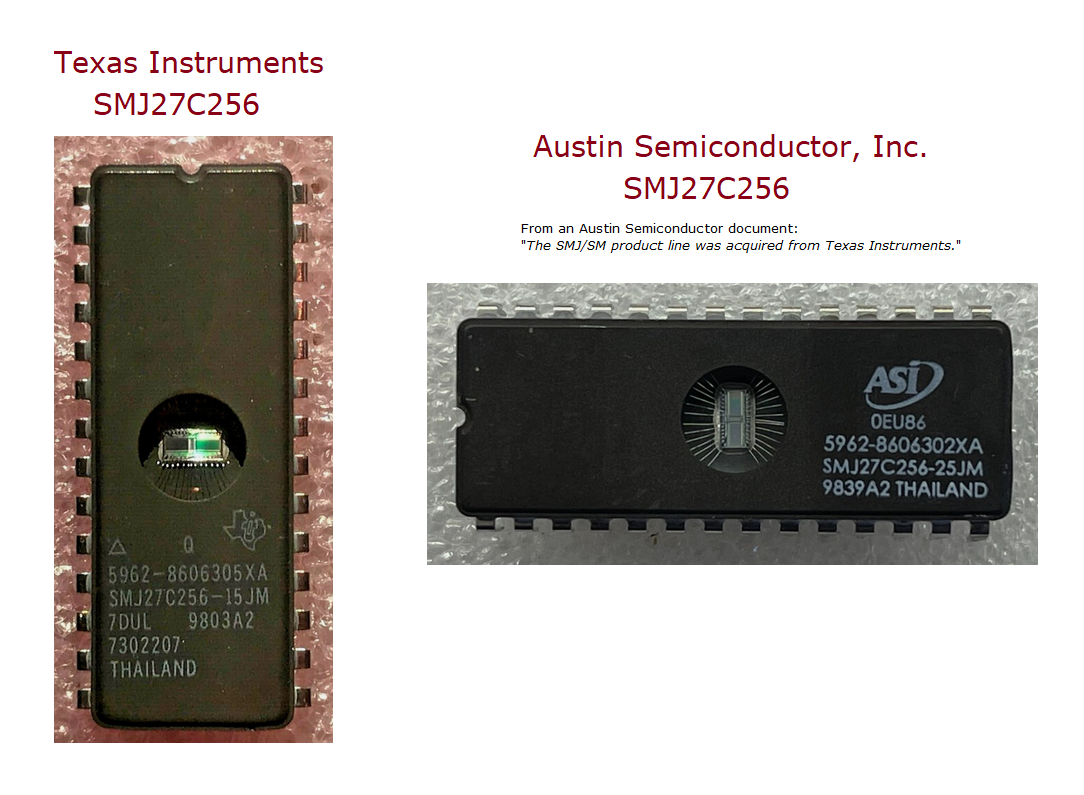
| Texas Instruments | SMJ27C256 | EPROM | Yes | pcdata76 at the VCFF | Do not confuse with the ASI version of the SMJ27C256 - see here. | ||
| Winbond | W27E257 | EEPROM | Yes | modem7 at the VCFF | See here. | Download | Yes (page 3) |
| Note 1 | Malc at the VCFF indicated suitability of the TMS27C256 for early 5160 motherboards. However, in 2026, ricsne2010 at the VCFF discovered that his Texas Instruments TMS27C256 (make-model verified by electronic signature) were unsuitable, behaving like the NEC µPD27C256 (first half cannot be read). Perhaps Texas Instruments changed the design of its TMS27C256 at some point/s. Later in 2026, modem7 at the VCFF located a TMS27C256-15 chip. Verified as Texas Instruments TMS27C256 via electronic signature (device ID). That chip worked (passed the test described in note 2 below). |
| Note 2 | Test by modem7 via: Step 1: Via EPROM programmer, I programmed the contents of U18 of the 10JAN86 BIOS set into the chip. CRC32 of that data is 1054F7BD. Step 2: Pin 1 lifted, then pin 1 was connected to ground. Step 3: Via EPROM programmer, contents of entire chip was verified. Step 4: As an extra verification, the read contents were exported to file, then the file contents verified as having a CRC32 of 1054F7BD. |
| Note 3 | Signetics was acquired by Philips. |